
Backyard birthday
60 guests, 4 hours, food served
3restrooms
- 2 standard restrooms
- 1 ADA accessible unit
- 1 hand wash station
Free restroom planning tool
Enter your headcount and hours and watch the site plan fill in with the restrooms, ADA unit and hand wash stations your day needs. Every count follows a published industry standard, and one tap sends the plan to us for a free rental quote.
Restroom planner
Pick event or job site, then adjust the numbers. The count, the site plan and the math update as you go.
Use your expected crowd, including staff and vendors.
Count the most people on site on a normal day, all trades included.
Welcome back. We kept the plan you made last time.
Short term rental. Delivery, setup and pickup are included in the rental fee.
A planning estimate built on published standards. A rental coordinator confirms the final count, placement and service schedule with you.
Site plan showing the restroom area for your plan.
Free rental quote
Send the form and an AAWSI rental coordinator will confirm availability, size the order and give you a price. Most quotes go out the same business day.
Your plan
Use the calculator above and your plan shows up here, ready to send with your request.
Need it today? Call (480) 830-9195.
We confirm availability and send pricing.
The method
Every count comes from a published standard, not a guess. Events and job sites follow different rules, so the calculator switches standards when you switch modes.
This is a planning tool. A rental coordinator confirms the count, the placement and the service schedule with you before anything is delivered.
Event sizing chart
There is no single ratio. At a four hour event the chart works out to about one unit per 50 guests at 100 people (2 units), one per 100 at 500 people (5 units) and one per 200 at 5,000 people (25 units). Longer events push every row up: the same 500 guests need 9 units at 8 hours.
| Guests | 1 hr | 2 hrs | 3 hrs | 4 hrs | 5 hrs | 6 hrs | 7 hrs | 8 hrs |
|---|---|---|---|---|---|---|---|---|
| 50 | 1 | 1 | 1 | 1 | 2 | 2 | 2 | 2 |
| 100 | 2 | 2 | 2 | 2 | 2 | 3 | 3 | 3 |
| 250 | 2 | 2 | 2 | 2 | 3 | 3 | 3 | 3 |
| 500 | 2 | 4 | 4 | 5 | 6 | 7 | 9 | 9 |
| 1,000 | 4 | 6 | 8 | 8 | 9 | 9 | 11 | 12 |
| 2,000 | 5 | 6 | 9 | 12 | 14 | 16 | 18 | 20 |
| 3,000 | 6 | 9 | 12 | 16 | 20 | 24 | 26 | 30 |
| 4,000 | 8 | 13 | 16 | 22 | 25 | 30 | 35 | 40 |
| 5,000 | 12 | 15 | 20 | 25 | 31 | 38 | 44 | 50 |
| 6,000 | 12 | 15 | 23 | 30 | 38 | 45 | 53 | 60 |
| 7,000 | 12 | 18 | 26 | 35 | 44 | 53 | 61 | 70 |
| 8,000 | 12 | 20 | 30 | 40 | 50 | 60 | 70 | 80 |
| 10,000 | 15 | 25 | 38 | 50 | 63 | 75 | 88 | 100 |
The chart comes from an independent study by the Center of Business and Industrial Studies at the University of Missouri-St. Louis. It assumes a 50/50 mix of men and women, no pumping during the event and about 200 uses per unit. The highlighted cell follows your plan in the calculator.
Construction sizing
OSHA's construction sanitation rule sets the minimum by crew size. ANSI/PSAI Z4.3 sets the count that keeps units clean between services. Here are both side by side for a 40 hour week.
| Workers | OSHA minimum | Z4.3, weekly service | Z4.3, serviced twice a week |
|---|---|---|---|
| 10 | 1 | 1 | 1 |
| 20 | 1 | 2 | 2 |
| 40 | 1 | 4 | 3 |
| 60 | 2 | 6 | 4 |
| 80 | 2 | 8 | 6 |
| 100 | 3 | 10 | 7 |
| 150 | 4 | 15 | 10 |
| 200 | 4 | 20 | 14 |
| 300 | 6 | 30 | 20 |
A standard unit has a toilet seat and a urinal, so it counts toward both OSHA columns. Units used only by construction crews follow these numbers; restrooms the public will use follow the event rules.
Worked examples
Each one runs through the same math as the calculator. Load any of them and adjust from there.
60 guests, 4 hours, food served
3restrooms
150 guests, 6 hours, bar and dinner, restroom trailer
5restrooms
2,500 people, 8 hours, bar and food trucks
37restrooms
45 workers, 50 hour weeks, a 3 to 6 month build
6restrooms
Choosing equipment
Both work. The choice comes down to the crowd, the look you want for the day and the budget.
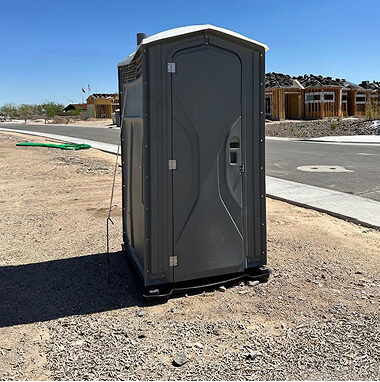
Single unit porta potties for crews and crowds, serviced on the schedule your job actually runs on. They go almost anywhere a service truck can reach, and the count scales from one unit at a backyard party to dozens at a festival.
Pair them with an ADA accessible unit when the public will use them, and with hand wash stations near any food.
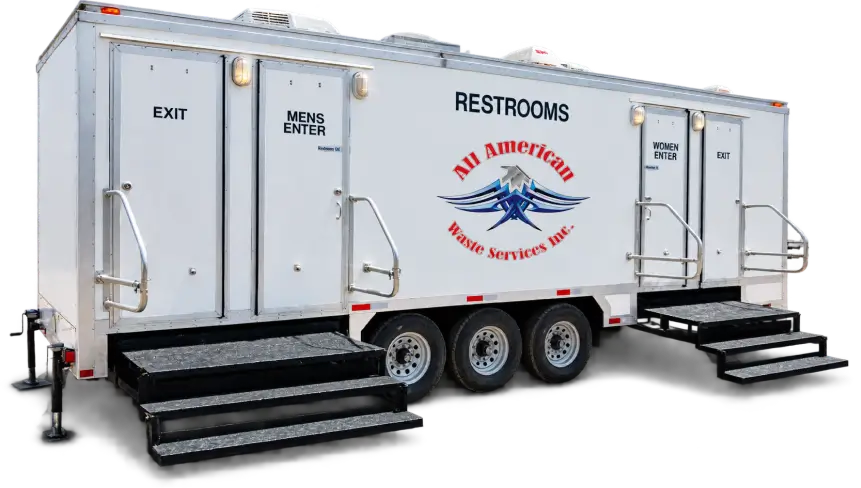
Multi stall mobile bathrooms that give guests a real restroom at weddings, corporate events and outdoor venues. The calculator counts one trailer stall for each unit the chart calls for and suggests the closest trailer size.
Trailers have sinks inside, so you only add hand wash stations near food. Running a multi day event or housing a remote crew? Ask about mobile shower trailers with private shower stalls, toilets and sinks.
Before delivery
The standards set the starting number. These are the conditions we ask about before anything goes on the truck.
Hot days mean more water and more trips to the restroom, a point PSAI makes in its own rental guidance. Busy Valley sites and summer job sites usually move from weekly to twice weekly service, because heat and volume together are what make a unit unpleasant.
A bar raises the count by about 15 percent. Food changes the hand wash plan from one station per 4 restrooms to one per 2.
The PSAI chart assumes no pumping during the event and about 200 uses per unit. Past 8 hours, or across several days, service between days is what keeps the count working.
Wind and washouts are real risks between June and September. If your site is exposed, tell us and we will talk through placement before the units go down.
Units have to sit where a service truck can reach them and an inspector will pass them. Have the address or a GPS point, a spot the truck can reach and an on site contact ready.
If the site is gated, badged or has an escort requirement, tell us up front so the driver is not turned around at the gate.
Why AAWSI
All American Waste Services has placed and serviced portable restrooms since 2004. Our daily runs cover Maricopa, Pinal and Gila counties, and rural or ranch property is handled case by case based on distance, access and unit availability.
Questions we get every day
For a 100 guest event, the PSAI chart calls for 2 restrooms for up to 5 hours and 3 for 6 to 8 hours. If alcohol is served, add 15 percent, which takes a 4 hour party from 2 to 3. Plan on one ADA accessible unit when the public will use the restrooms, and at least one hand wash station.
There is no flat ratio. At a four hour event the PSAI chart works out to about one restroom per 50 guests at 100 people, one per 100 at 500 people and one per 200 at 5,000 people. Longer events and alcohol push every number up, which is why the calculator asks for hours and bar service.
OSHA 1926.51(c)(1) requires one toilet for 20 or fewer workers, then one toilet seat and one urinal for every 40 workers, and one of each per 50 workers once the crew reaches 200. A standard portable unit has a seat and a urinal, so a crew of 40 needs 1 unit, 80 needs 2 and 250 needs 5. That is the legal minimum.
OSHA sets the floor. ANSI/PSAI Z4.3, the industry standard for portable sanitation, calls for one unit per 10 workers on weekly service, or one per 15 when units are serviced more than once a week, so they stay usable between visits. For 60 workers on a 40 hour week that is 6 units with weekly service or 4 with twice weekly service, against an OSHA minimum of 2. The calculator shows all three so you can choose.
If the public will use the restrooms, plan on it. Under the 2010 ADA Standards (section 213.2), a cluster of portable units meets accessibility rules when 5 percent of the units in each cluster are accessible, so even a small bank needs one. The calculator adds one accessible unit for every 20 restrooms and never fewer than one.
The calculator plans one hand wash station for every 4 restrooms at an event, one for every 2 when food is served, and one for every 2 restrooms on a job site. OSHA 1926.51(f) also calls for washing facilities near the work for crews applying paint, coatings, herbicides or insecticides, or working with other harmful contaminants.
Standard service on a long term rental is once a week: pumping, sanitizing and supply restock. High traffic Valley sites and summer job sites usually move to twice a week. Events are priced as a short term rental with delivery, setup and pickup in one fee, and multi day events usually move to a more frequent schedule.
Standards referenced: OSHA 29 CFR 1926.51, PSAI guidance on renting portable units, ANSI/PSAI Z4.3 and the 2010 ADA Standards for Accessible Design.
Send the plan with your dates and delivery address. Most quotes go out the same business day.